Bhuj city was founded in 1510 by the local ruler Maharao Hamir. During the reign of Rao Khengarji I Bhuj was made capital of the prosperous princely state of Kutch, whose wealth was derived from its sea trade. Bhuj remained an independent princely state also during the British rule. In 1947 when India got independence Bhuj became part of India. This was a fascinating walled city, with beautiful palaces, havelis and market famous for its rich handicrafts and jewellery until the earthquake of 2001 which reduced much of Bhuj to rubble. But now some of cities building have been restored and efforts are on to bring the city back to its earlier developed stage.

The Darbargadh palace complex was begun by the princes of Kutch in 1548 and was added to over several centuries. It reflects the artistic and cultural development of the city. The royal chambers of this complex have beautiful designs contrasting with European style in the exterior of the palace. The last palace built here in 1868 is Prag Mahal, in red sandstone and white marble under the direction of British architects. It’s worth visiting for its ghostly Durbar Hall. The oldest portions of the Darbargadh palace were vacated in the nineteenth century and following independence, the palace complex became a privately owned museum. It also houses Aina Mahal. After the earthquake that struck in 2001, which destroyed the complex, it has been restored by The Indian National Trust for Arts and Cultural Heritage (INTACH).
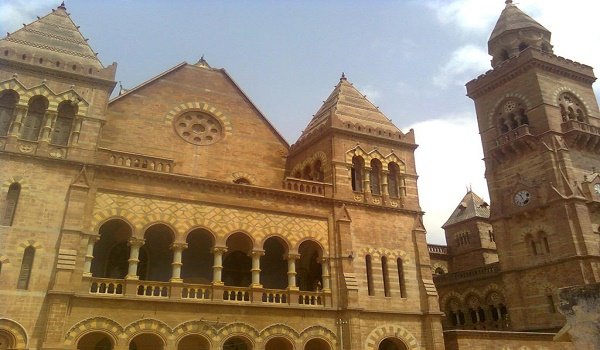
Aina Mahal or `Palace of Mirrors’ was built by Rao Lakhpatji in 1752 AD. Aina Mahal is a part of a large palace complex of Darbargarh Palace. It is a two storey building with Darbar Hall, hall of mirrors and suites for royal family. A Gujarati local craftsman Ramsingh Malam went to Netherlands where he perfected his skills in glassmaking, tile-making, iron founding and clock-making. After he returned back, the ruler of Kutch, Rao Lakha gave him an opportunity to display these skills. Aina Mahal was thus decorated with hall of mirrors of Venetian glass. The Hall of mirror has white marble walls which are covered with mirrors and gilded ornaments and the floor is lined with tiles.

This museum has excellent choice collection of Kutch textiles, culture, local crafts including reconstructed village of Rabari bhungas (mud-and-mirrorwork huts), musical instruments and many wood and stone carvings. It’s chief attractions includes a rare fossil of a Crocodilian which is an extinct species of the crocodile of the modern age. This creature was double the size measuring of a crocodile of today.

Banni villages are well known for its beautiful embroideries, colourful traditional culture. Located at some distance from the city, these villages also has the crafts hubs of Hodka, Dhordo and Khavda where decorated mud thatch-roofed huts (liponkan) form the stop-off for meeting with traditional Rabari and Ahir cultures and also an opportunity to inspect their handiwork and wares. Some of the villages are famous for weaving, block printing, embroidery and traditional nut crackers.
Bhuj,India
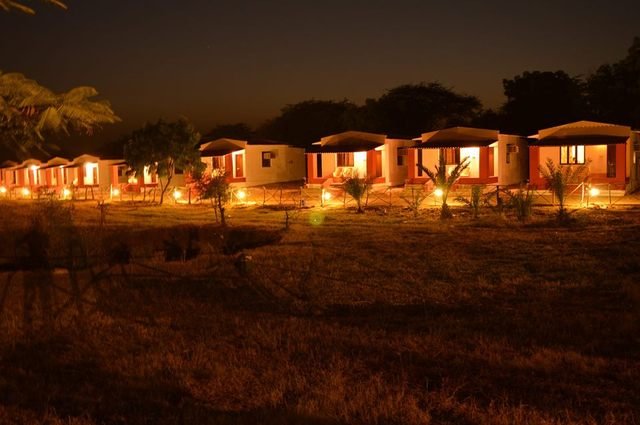
On the outskirts of Bhuj, in the Rann of Kutch lies The Kutch Safari Lodge, it is an ideal home base, for excursions into the deeper landscape of the white desert, and to experience the unique lifestyle and beautiful traditional Banni Villages known for their handicrafts.The Rustic "KUTCHI" a traditional home of the Kutchi Peopl...
Population: 148,834
Average Climate:
| Summer: | 27° C – 35° C |
| Winter: | 17° C – 25° C |
Best time to visit: October to March